Why Businesses Are Investing in Zillow Clone Scripts for Real Estate
Discover why businesses invest in Zillow clone scripts, their key features, development process, costs, scalability, and benefits for launching real estate platforms.
16 min read
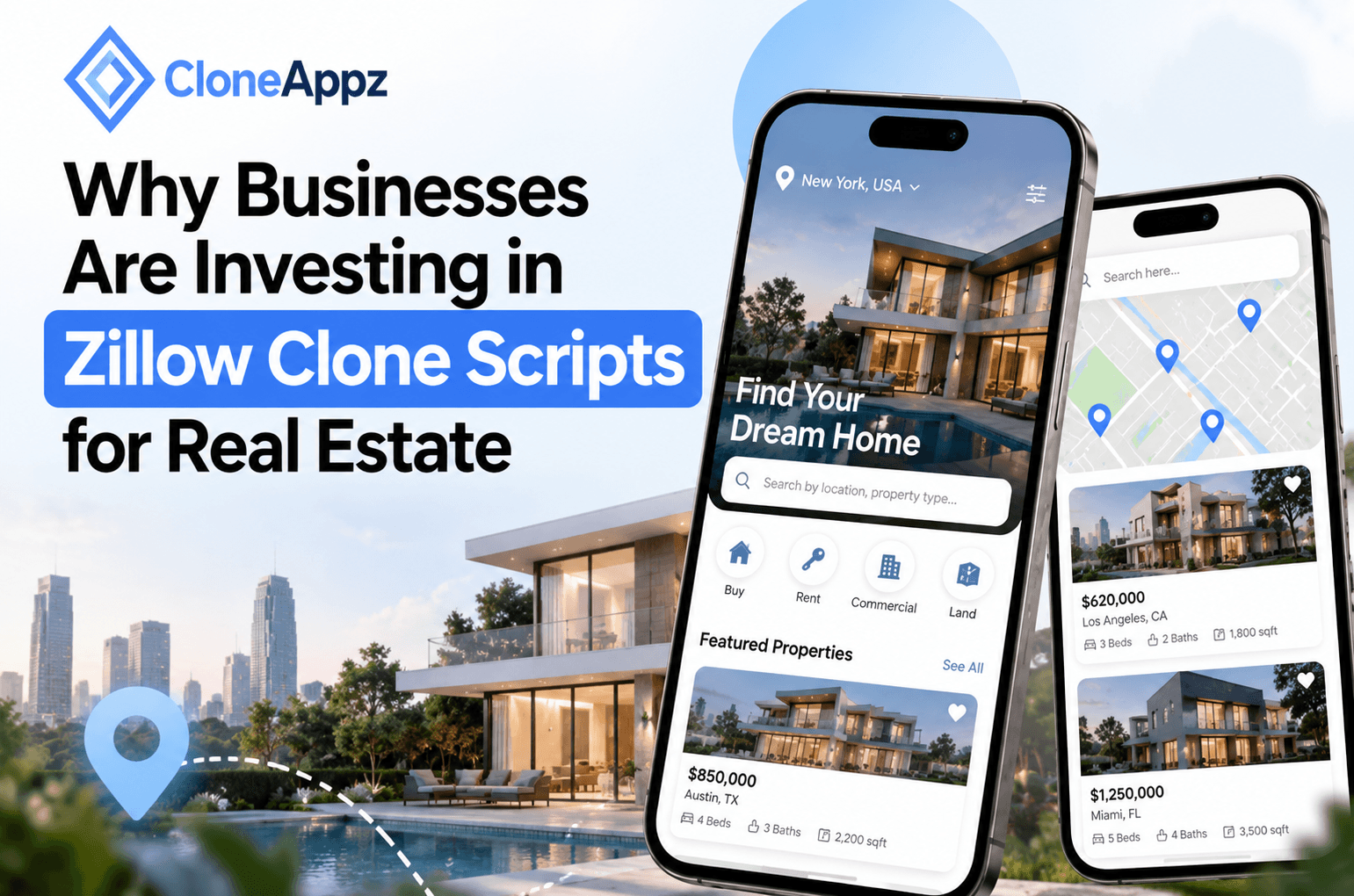
The real estate industry is undergoing a major digital transformation as buyers, sellers, landlords, tenants, agents, and property managers increasingly depend on online platforms to discover and manage properties. Traditional property-search methods are gradually being replaced by digital marketplaces that allow users to search listings, compare properties, contact agents, schedule viewings, and manage transactions from a single platform. This shift has created significant opportunities for businesses planning to enter or expand within the property technology market.
Platforms such as Zillow have demonstrated how technology can simplify property discovery and connect multiple stakeholders through a centralized digital ecosystem. However, building a real estate marketplace from scratch can require substantial development time, technical resources, and investment. This is where a Zillow clone script can provide a practical starting point for businesses that want to launch a feature-rich property marketplace without developing every core component from the ground up.
A Zillow-inspired platform can include property listings, advanced search, location-based discovery, map integration, user accounts, agent profiles, property recommendations, mortgage-related tools, communication features, administrative controls, and analytics. Businesses can further customize these capabilities according to their target market, business model, and geographical requirements.
For companies looking to enter this competitive market, the objective should not simply be to replicate an existing platform. Instead, the focus should be on developing a scalable real estate technology solution with a differentiated user experience, reliable architecture, flexible integrations, and monetisation capabilities.
What Is a Zillow Clone Script and How Does It Work for a Real Estate Business?
A Zillow clone script is a pre-built or semi-customisable software solution designed to provide the fundamental functionality required for a property marketplace similar to Zillow. It typically includes modules for property listing management, property discovery, user registration, agent management, location-based searches, communication, payments, notifications, and administration. Businesses can customise the platform's interface, features, workflows, branding, and integrations before launching it under their own brand.
Unlike a simple property listing website, a modern real estate marketplace usually serves multiple user groups. Property owners can publish listings, agents can manage properties and leads, buyers can search and shortlist properties, tenants can discover rental options, and administrators can monitor the entire ecosystem.
The underlying architecture generally consists of several interconnected components:
- Customer-facing web or mobile interfaces
- Property listing and inventory management
- User and agent authentication
- Search and filtering infrastructure
- Geolocation and mapping services
- Database and media storage
- Communication and notification systems
- Payment and subscription infrastructure
- Administrative dashboards
- Analytics and reporting systems
- Third-party API integrations
A properly engineered solution should also be designed to support increasing numbers of listings, users, searches, images, enquiries, and transactions as the business grows.
Why Are Businesses Choosing Zillow-Inspired Real Estate Platforms?
The growing demand for digital property services is one of the primary reasons businesses are exploring Zillow-style platforms. Consumers increasingly expect real estate services to provide the same convenience they experience across other digital marketplaces. They want to search properties quickly, refine results according to specific requirements, view photographs and videos, identify locations on maps, contact property professionals, and receive relevant updates.
For businesses, this creates several opportunities beyond simply publishing property listings.
A real estate marketplace can generate revenue through featured listings, agent subscriptions, advertising, lead-generation packages, premium property placements, transaction commissions, and other services. The platform can therefore become a technology-driven marketplace rather than a conventional property website.
Another important factor is the ability to establish a focused real estate marketplace for a specific region or property segment. A business could develop a platform for residential properties, commercial properties, luxury homes, rentals, student housing, vacation properties, new developments, or a combination of categories.
This flexibility allows businesses to build their own positioning instead of depending entirely on established property portals.
How a Zillow Clone Can Reduce the Complexity of Real Estate Platform Development
Developing a large-scale real estate marketplace from the ground up involves multiple development layers. Businesses need to plan the architecture, create interfaces, establish databases, develop APIs, implement authentication, integrate third-party services, build administrative functionality, test the system, and prepare infrastructure for deployment.
Starting with a pre-built foundation can reduce some of this initial complexity.
A Zillow clone can provide commonly required marketplace modules that developers can customise according to the business requirements. This approach allows the development team to concentrate more heavily on custom functionality, user experience, integrations, performance, and business-specific features.
However, businesses should carefully evaluate the underlying technology before selecting a solution. A script should not be chosen solely because it contains a long feature list. Code quality, scalability, security, database architecture, API structure, documentation, customisation capabilities, and post-launch support are equally important.
For businesses considering Zillow clone app development, technical due diligence should therefore be part of the planning stage.
Core Features a Zillow-Style Real Estate Platform Should Include
A successful real estate marketplace requires more than a visually attractive property catalogue. Its features should support the complete property discovery and enquiry journey.
Advanced Property Search and Filtering
Search functionality is one of the most important components of a property marketplace. Users should be able to search based on location, property type, price range, number of bedrooms, bathrooms, area, amenities, furnishing status, availability, and other relevant parameters.
More advanced platforms can also support keyword-based search, saved filters, sorting options, radius-based searches, and personalised recommendations.
Interactive Maps and Location-Based Property Discovery
Map functionality allows users to understand where properties are located and compare listings geographically. Integration with mapping services can provide coordinates, markers, location searches, neighbourhood information, and directions.
Businesses can also develop location-specific experiences such as searching properties within a selected radius or identifying listings close to schools, hospitals, transportation facilities, shopping centres, or other points of interest.
Property Listing Management
Property owners and agents should have tools to create, edit, publish, pause, and remove listings. Listing forms can include property descriptions, photographs, videos, floor plans, pricing, amenities, property type, location, availability, and contact information.
A structured listing system also makes it easier for administrators to review content and maintain marketplace quality.
Agent and Property Owner Profiles
Professional profiles can help users identify the people or organisations behind property listings. Agents can display their experience, contact details, listings, service areas, and other relevant information.
This functionality can also support lead management by connecting enquiries with the appropriate property professional.
Property Images, Videos, and Virtual Tours
Visual content has become an important part of online property discovery. High-resolution images, property videos, floor plans, and virtual tours can help users evaluate properties before arranging physical visits.
The technical architecture should therefore include efficient media storage, image compression, responsive delivery, and suitable CDN infrastructure.
Saved Properties and Search Alerts
Users should be able to save properties that interest them and return to those listings later. Search alerts can further improve engagement by notifying users when new properties match their saved criteria.
Notifications can be delivered through email, push notifications, SMS, or other communication channels depending on the platform's architecture.
In-App Communication and Enquiry Management
A real estate marketplace can include enquiry forms, direct messaging, agent communication, appointment requests, and viewing schedules.
These tools help transform property searches into measurable leads and give agents a central location for managing potential customers.
What Technology Stack Can Power a Zillow-Inspired Platform?
The technology stack should be selected according to expected traffic, functionality, development budget, geographical requirements, and long-term scalability.
For the frontend, businesses may use technologies such as React, Next.js, Vue, or other modern frameworks for responsive web experiences. For mobile applications, Flutter or React Native can provide cross-platform development, while native Android and iOS development can be considered when platform-specific capabilities are required.
The backend can be developed using Node.js, Laravel, Django, or comparable frameworks. PostgreSQL and MySQL can support structured property and user data, while MongoDB may be considered for particular data models and application requirements.
Caching systems such as Redis can improve response times for frequently requested data. Cloud infrastructure from providers such as AWS, Google Cloud, or Microsoft Azure can provide scalable hosting, storage, database, networking, and monitoring capabilities.
The appropriate stack depends on the business requirements rather than a single universal technology choice.
Why API Integration Is Critical for a Modern Real Estate Marketplace
A real estate marketplace normally depends on several external services. This makes API integration a core technical requirement rather than an optional enhancement.
Mapping APIs can provide geolocation and map functionality. Payment APIs can process subscriptions or listing-related payments. Communication APIs can support SMS, email, or messaging. Authentication services can simplify secure login processes, while analytics APIs can provide business intelligence.
Other integrations may include mortgage calculators, property data providers, CRM platforms, identity verification systems, social login services, cloud storage, property valuation tools, and notification platforms.
A well-designed API layer should use authentication, rate limiting, validation, error handling, logging, and monitoring. APIs should also be structured so that external services can be replaced or upgraded without requiring major changes throughout the application.
How MVP Development Can Help Validate a Real Estate Business Model
Launching every possible feature at the beginning can increase development complexity and delay market entry. MVP development provides an alternative approach by focusing on the functionality required to validate the core business proposition.
For a real estate marketplace, an initial MVP could include:
- User registration and authentication
- Property listing creation
- Property search and filtering
- Property detail pages
- Map integration
- Agent profiles
- Enquiry functionality
- Admin dashboard
- Basic notifications
- Listing management
Once the platform starts receiving real user data, the business can identify which features require improvement and which additional capabilities can generate value.
Later versions can introduce AI-powered recommendations, advanced analytics, virtual tours, subscription plans, automated lead scoring, mortgage tools, property valuation systems, and other advanced functionality.
This staged approach can make the development roadmap easier to manage while allowing the business to validate its marketplace concept.
How Businesses Can Monetise a Zillow-Style Real Estate Platform
Revenue generation should be considered during the architecture and product-planning stage rather than added after development.
A platform can implement several monetisation models.
Featured Property Listings
Agents or property owners can pay to increase the visibility of selected listings. Featured properties can appear higher in search results or within dedicated promotional sections.
Agent Subscription Plans
Real estate professionals can subscribe to monthly or annual packages offering different numbers of listings, leads, analytics, promotional tools, or account features.
Lead Generation Packages
Businesses can charge agents for qualified enquiries generated through the marketplace. The pricing model can be based on individual leads, packages, or subscription tiers.
Advertising
Relevant businesses such as mortgage providers, insurance companies, moving services, interior designers, and property management firms can advertise on the platform.
Premium Business Profiles
Agencies can pay for enhanced profiles containing additional branding, property showcases, contact options, analytics, and promotional features.
The selected model should align with the target market and user behaviour rather than simply copying another company's revenue structure.
How to Create a Website Like Zillow With a Scalable Architecture
Businesses planning how to create a website like Zillow should begin with requirements rather than immediately moving into interface development. The first stage should define the target audience, property categories, geographical coverage, monetisation strategy, user roles, and core workflows.
The next stage involves architecture planning. Developers need to determine how listings, users, agents, enquiries, media files, subscriptions, payments, and notifications will be stored and communicated.
The platform should ideally use modular architecture so that individual services can evolve independently. For example, search functionality can be improved without rebuilding the user authentication system.
Search infrastructure is particularly important for large property marketplaces. As listing volumes increase, conventional database queries may become insufficient for sophisticated search requirements. Search technologies such as Elasticsearch or OpenSearch can be considered for advanced filtering, indexing, ranking, and location-based discovery.
Caching, CDN delivery, database indexing, background jobs, load balancing, and automated monitoring can further improve performance.
Steps Involved in Zillow Clone App Development
A structured development process helps reduce technical risks and keeps the product aligned with business requirements.
Step 1: Business and Technical Requirement Analysis
The development team identifies target users, business objectives, property categories, monetisation methods, required integrations, geographical requirements, and regulatory considerations.
Step 2: UI/UX Design
The interfaces for buyers, sellers, agents, administrators, and other users are planned. Search, property discovery, listing creation, enquiries, and account management should have clear workflows.
Step 3: Backend and Database Development
Developers establish APIs, authentication, database structures, property management modules, user management, permissions, and core business logic.
Step 4: Frontend and Mobile Development
The web or mobile interfaces are connected with backend APIs. Responsive layouts and platform-specific functionality are implemented according to the project requirements.
Step 5: Third-Party Integrations
Mapping, payment, communication, analytics, authentication, cloud storage, and other required services are integrated and tested.
Step 6: Testing and Security
Functional testing, API testing, performance testing, compatibility testing, security testing, and usability testing should be performed before launch.
Step 7: Deployment and Monitoring
The application is deployed to cloud infrastructure with appropriate monitoring, backups, logging, security controls, and performance tracking.
Step 8: Continuous Development
After launch, analytics and user feedback can guide future releases, feature improvements, performance optimisation, and new integrations.
Build an App Like Zillow With Custom Features for a Specific Market
A property marketplace does not necessarily need to reproduce every function available on an established platform. Businesses can differentiate their products by solving specific problems within their chosen market.
For example, a platform targeting luxury real estate could emphasise high-quality visual media, private listings, verified agents, virtual tours, and appointment management. A rental-focused marketplace could prioritise tenant applications, rental availability, recurring payments, and lease management.
Similarly, a commercial property platform could include office specifications, floor areas, investment information, lease terms, and business-location data.
This is where customisation becomes important. The foundation can provide common marketplace functionality while the business adds features specifically designed for its customers.
White Label Real Estate App Development for Faster Brand Launches
A white label real estate app can allow businesses to launch a branded property marketplace using an existing technical foundation. The interface, logo, colours, domain, workflows, features, and business rules can be customised according to the company's requirements.
This model can be particularly useful for real estate agencies, property technology startups, entrepreneurs, regional property portals, and businesses entering a new geographical market.
However, white-label does not necessarily mean that every platform should remain identical. A strong implementation should allow meaningful customisation of both the user interface and underlying functionality.
CloneAppz provides Zillow-inspired real estate development solutions that can be customised according to a company's business model, target market, required features, integrations, and branding requirements. The development process can include MVP planning, UI/UX design, backend development, API integration, testing, deployment, and ongoing technical improvements.
How to Create an App Like Zillow With Advanced Technology
Modern real estate platforms can incorporate emerging technologies to improve discovery, personalisation, and operational efficiency.
Artificial intelligence can analyse user behaviour and property preferences to provide personalised recommendations. Machine learning models can assist with lead scoring, property matching, demand analysis, and content classification.
Computer vision can potentially be used to categorise property images or identify visual characteristics. Conversational interfaces can help users search properties using natural-language queries.
For example, instead of manually applying several filters, a user could enter a query describing their requirements and receive relevant property results.
Virtual and augmented reality technologies can also provide immersive property viewing experiences, particularly for remote buyers and international investors.
These technologies should be introduced according to actual business requirements. Adding technology without a clear user or commercial benefit can increase development and maintenance complexity.
Security and Data Protection Considerations for a Real Estate Marketplace
Real estate platforms handle sensitive information such as names, contact details, account credentials, property ownership information, enquiries, payment records, and potentially identity documents.
Security therefore needs to be incorporated into the architecture from the beginning.
Important measures include encrypted data transmission, secure password storage, role-based access controls, API authentication, input validation, secure payment processing, database protection, audit logging, regular backups, vulnerability testing, and monitoring.
Administrators should also have granular permissions so that sensitive operations are limited to authorised personnel.
Businesses operating across different countries should additionally evaluate the privacy and data-protection requirements applicable to their target markets before launching.
What Makes a Zillow Clone Scalable for Long-Term Growth?
Scalability should be considered from the earliest architecture stage. A platform that performs well with a few thousand listings may face challenges when it reaches millions of records and significantly higher traffic.
Several technical strategies can help prepare the platform for growth:
- Database indexing and query optimisation
- Horizontal application scaling
- Load balancing
- CDN-based media delivery
- Caching with Redis or similar systems
- Asynchronous background processing
- Search indexing
- Cloud-based storage
- Automated monitoring
- Containerisation and deployment automation
- Database backup and recovery systems
The architecture should also separate critical services where necessary. For example, image processing, notification delivery, search indexing, and analytics workloads can be handled asynchronously so they do not unnecessarily slow down the main user experience.
Why Customisation Matters More Than Simple Feature Replication
The purpose of developing a Zillow-inspired platform should be to create a competitive business asset rather than simply reproduce an existing website.
A business may need different property categories, local search behaviour, payment methods, languages, currencies, verification processes, commission structures, and legal requirements.
Customisation can also help create a unique user experience. Branding, navigation, property discovery, recommendations, agent tools, dashboards, and communication features can all be adapted to the target audience.
Businesses should therefore evaluate a Zillow clone based on how effectively it can evolve with their requirements.
How Much Does It Cost to Develop a Zillow-Inspired Real Estate Platform?
The cost depends on the platform's scope, number of applications, design complexity, integrations, backend architecture, technology stack, custom features, and development team.
A basic MVP with core property marketplace functionality generally requires less investment than a full-scale platform with advanced search, AI recommendations, sophisticated analytics, multiple mobile applications, payment systems, virtual tours, and extensive third-party integrations.
The development process can be divided into stages to manage investment more effectively. Businesses can begin with an MVP, validate the marketplace, and then introduce advanced functionality based on real usage and business priorities.
The final budget should therefore be established after technical requirements, user roles, feature specifications, integrations, and infrastructure requirements have been documented.
Final Thoughts on Investing in a Zillow Clone Script
The growing demand for digital property discovery is creating opportunities for businesses to develop specialised real estate marketplaces. A Zillow-inspired platform can provide the technical foundation for connecting property owners, agents, buyers, tenants, and other participants through a single digital ecosystem.
However, successful development requires more than replicating visible features. Businesses need to consider architecture, scalability, search performance, security, API integration, monetisation, user experience, mobile accessibility, and long-term customisation.
Starting with a well-planned MVP can help validate the concept before larger investments are made. As the marketplace grows, advanced search, AI recommendations, analytics, virtual property experiences, automation, and additional integrations can be introduced.
For businesses seeking a structured approach to launching a property marketplace, CloneAppz can support Zillow-inspired app development with custom functionality, branded interfaces, scalable architecture, and integration capabilities designed around specific business requirements.
Frequently Asked Questions
A Zillow clone script is a pre-built real estate marketplace solution containing core features such as property listings, search, filters, maps, user accounts, agent management, enquiries, notifications, and administration. It can be customised for a specific business and market.
Yes. A platform can be customised with your branding, property categories, workflows, monetisation model, location requirements, payment methods, integrations, and additional features.
Development time depends on the scope. An MVP can generally be delivered faster than a complete platform with advanced search, AI, multiple applications, complex integrations, and enterprise-level infrastructure. A detailed technical specification is required for an accurate timeline.
Yes. A real estate marketplace can include a responsive website along with dedicated Android and iOS applications. Cross-platform frameworks can also be considered when appropriate.
Common integrations include mapping and geolocation APIs, payment gateways, communication APIs, cloud storage, authentication services, analytics platforms, property data services, and CRM systems. The exact integrations depend on the business model and target market.
Yes. MVP development can help a startup launch essential marketplace functionality, collect user feedback, validate demand, and understand which features should receive priority in subsequent development phases.