Venmo Clone: How to Build a P2P App Like Venmo
Explore what a Venmo clone is, how it works, must-have features, and the real costs of building a P2P payment app like Venmo. Get a free consultation today.
12 min read
Cash is losing its grip on how people pay each other back. Ask anyone under 30 how they split a dinner bill, and cash is probably not the answer. They tap a few buttons on their phone, and the money moves in seconds.
This shift is not small. The global P2P payment market crossed USD 3.6 trillion in 2025 and is on track to grow past 17% a year through the next decade.
That is not a niche trend anymore; it is a full-blown shift in how people move money, and it has opened a real door for founders, banks, and fintech teams who want in.
This is where the idea of a Venmo clone comes in.
If you have been researching how to build an app like Venmo, or you are comparing a Venmo clone script against building from the ground up, this guide walks you through it properly with substantial information you actually need to know before you make a decision.
What is a Venmo Clone?
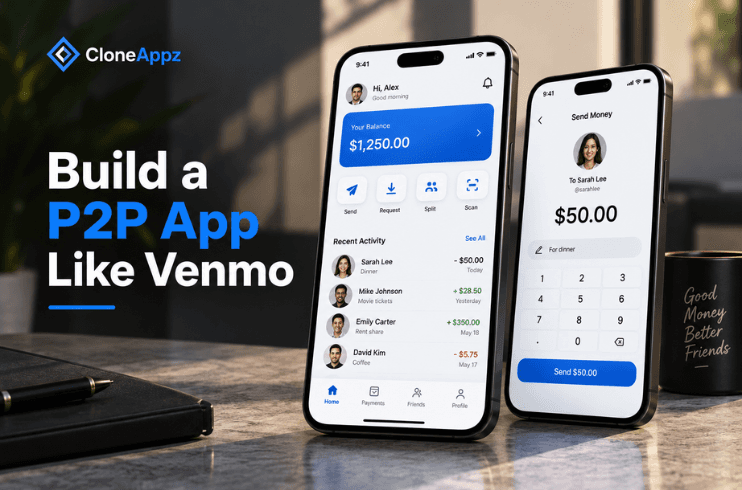
A Venmo clone is a ready-made P2P payment app built to replicate Venmo's core experience. Think sending money, requesting money, splitting bills, and a simple wallet, all wrapped in a clean interface. The difference is you are not starting from a blank screen. You are starting from a working product.
The Core Idea Behind It
At its heart, a Venmo clone app gives users a digital wallet and a way to move money to friends, family, or businesses instantly. No need to touch a bank teller or wait two days for a wire transfer. It is peer-to-peer, which just means the money goes from one person to another without a middleman slowing things down.
Why Founders Choose a Ready-Made Script Over Building From Scratch
Building a payment app from zero is expensive and slow. You need developers who understand banking APIs, compliance teams who know KYC and AML rules inside out, and months of testing before you can even think about launching.
A Venmo clone script skips most of that groundwork.
Founders who choose this route are not being lazy, but practical. Time in fintech is money, quite literally, and every month spent coding from scratch is a month a competitor could be signing up your future users.
Who Actually Buys These Scripts
It is a mixed crowd, honestly. Regional banks want to offer P2P features without a two-year IT project. Fintech startups want a working MVP to show investors. Super-app owners want to add payments to apps that already have millions of users, such as delivery or social media apps.
Why the P2P Payment Market is Still Worth Entering in 2026
Some people assume this space is already crowded out by PayPal, Venmo, and Zelle in the US, or by regional giants elsewhere. Fair point, but the numbers tell a different story.
The Market Numbers are Hard to Ignore
Mobile app-based P2P payments already account for more than 55% of all P2P transaction volume. Smartphone penetration has crossed 72% globally, and in developed markets like the US, over 82% of smartphone users already have at least one P2P app installed.
Analysts at Precedence Research put the global market at roughly USD 4.28 trillion in 2026, heading toward USD 18 trillion within a decade.
Gen Z is a big part of this. Around 71% of Gen Z users rely on P2P apps for splitting bills and small transfers under 50 units of local currency. That is a generation that grew up assuming money moves as fast as a text message. They are not going back to writing checks.
Why "Create an App Like Venmo" Keeps Trending Outside the US
Here is something interesting.
A lot of the search demand around this topic is not coming from Silicon Valley. It is coming from Southeast Asia, the Middle East, and parts of Africa, where digital wallets are filling gaps that traditional banking never covered.
In these regions, a huge chunk of the population is still underbanked, and a simple app that lets them send money to a cousin in another city solves a real problem.
The White Label Advantage
This is where a white label fintech app earns its keep. Instead of negotiating with five different banking partners and building compliance from scratch, you license infrastructure that already works.
You focus on branding, local partnerships, and getting users on board, while the backend handles the heavy lifting.
How a Venmo Clone App Actually Works
Let's pull back the curtain a bit, because most blogs on this topic stop at "users send money" and call it a day. There is more going on underneath.
The User Journey, Step by Step
- A new user downloads the app and signs up with a phone number or email.
- Next comes identity verification, usually a quick KYC check with a government ID and maybe a selfie.
- Once verified, they link a bank account or debit card, and from there, they can send, request, or receive money in a few taps.
What Happens Behind the Scenes
Every transaction touches a ledger system that records who sent what, to whom, and when. This ledger has to be accurate to the cent, every single time, because a payment app that miscounts money does not survive long.
Behind that ledger sits the actual payment rail, which could be an ACH transfer in the US, a UPI-style rail in India, or a card network depending on the region.
Instant Transfers vs. Standard Bank Transfers
Here is a detail most competitor pages skip entirely, and it happens to be one of the more interesting parts of the business model.
Standard bank transfers usually settle in one to three business days and cost the platform very little.
Instant transfers cost more to process because they move through card networks, so platforms often charge a small fee, typically 1% to 1.75%, for the privilege of getting cash in your account within minutes.
This one feature alone can become a meaningful revenue stream once you have decent transaction volume.
Compliance Checkpoints You Cannot Skip
KYC and AML are essential for any legitimate payment app. Real-time monitoring detects unusual activity, such as a new account moving large amounts of money. Tokenization also keeps card and bank details safe by ensuring raw numbers are not stored as plain text.
Over 67% of P2P payment apps now use tokenization as a baseline security measure, and that number keeps climbing every year.
Must-Have Features When You Build an App Like Venmo
A feature list on its own is boring. What matters is which features actually move the needle for users and which ones just look good in a sales deck.
Core P2P Features Users Expect
- Send and request money, obviously.
- A digital wallet to hold balances.
- Bill splitting for group expenses, which turns out to be one of the most-used features among younger users.
- QR code payments for quick in-person transfers, especially useful for small merchants and street vendors in emerging markets.
The Social Layer That Made Venmo Different
Here is something worth noting. Venmo did not win by being the fastest payment app. It won partly because of its social feed, where users could see (with amounts hidden) that their friends paid each other for pizza or rent.
That small social nudge kept people opening the app even when they were not actively paying anyone.
A private chat feature for context around payments, like "here's your half for Uber," adds a human touch that pure utility apps miss.
Security Features for Building Trust
- Biometric login through fingerprint or Face ID.
- Two-factor authentication for larger transfers.
- Fraud monitoring that runs quietly in the background.
None of these are flashy, but users notice fast if they are missing, especially after a few years of headlines about data breaches.
Advanced Features Worth Considering
Multi-currency support and live exchange rates matter a lot if you are targeting cross-border users. Invoicing tools help small businesses use the app for actual commerce, not just splitting brunch.
And if your audience overlaps with crypto users, wallet integration for Bitcoin or Ethereum can open up an entirely different revenue stream, though it comes with its own layer of regulatory complexity.
Venmo Clone Script vs. Custom Development: Which Should You Choose?
This is probably the question that brought most readers to this page in the first place.
Cost and Timeline, Honestly Compared
Custom development from scratch can take twelve to eighteen months and easily run into six or seven figures once you add compliance, security audits, and QA. A Venmo clone script, by comparison, can get a working, branded app into your hands in a matter of weeks, at a fraction of the cost.
That difference is not marginal. It is often the gap between launching this year or launching two years from now.
When a White Label Foundation Makes More Sense
If your business model depends on speed to market, like grabbing a regional opportunity before a bigger player notices it, a white label digital wallet foundation is the smarter bet.
Banks exploring digital-first services also lean this way, since a white label banking app lets them test P2P features without overhauling their entire core banking system.
Where Customization Still Matters
That said, a script is not a copy-paste job. Branding needs to feel native to your market, not like a reskinned template.
Compliance requirements shift from country to country, so your KYC flow in the UAE will look different from one built for the US. Good development partners build this flexibility in from day one instead of bolting it on later.
Beyond Venmo: How This Compares to Other P2P and Wallet Models
It helps to see where a Venmo clone sits next to its cousins, because the terms get thrown around loosely.
Venmo Clone vs. Cash App Clone
A CashApp clone typically leans harder into investing features, like buying stocks or Bitcoin directly within the wallet. A Venmo clone stays closer to its social P2P roots, prioritizing the send-and-split experience over investment tools.
Both share the same underlying wallet infrastructure, so the choice usually comes down to what your target audience actually wants to do with their money.
Venmo Clone vs. Trust Wallet Clone App
This comparison trips people up a lot. A trust wallet clone app is built around custodial-free crypto storage, meaning the user holds their own private keys.
A Venmo clone is custodial and fiat-first, meaning the platform manages the funds and the user deals in regular currency. They solve different problems for very different audiences.
Where White Label Fintech Is Heading Next
Expect more overlap between these categories going forward. Embedded finance is pushing wallets, lending, and even micro-investing into the same app experience, and the lines between "payment app" and "financial super-app" are getting blurrier every year.
What Does it Cost to Develop a Venmo Clone App?
Everyone wants a number here, and fair enough. But the honest answer is that it depends on a handful of specific factors.
The Factors That Actually Drive Cost
Feature scope is the biggest one. A basic send-and-receive app costs far less than one with crypto integration, invoicing, and multi-currency support. Compliance requirements add cost too, since operating in multiple countries means meeting multiple regulatory standards at once.
The level of custom branding and UI design also plays a role, along with how much post-launch support you need.
A Realistic Range
Most white label Venmo clone builds fall somewhere in the range of a modest five-figure investment for a lean MVP, climbing well into six figures for a fully custom, multi-market build with advanced features.
Anyone promising an exact number without knowing your feature list and target markets is probably guessing.
Costs Founders Often Forget
- Licensing fees for payment gateway partnerships.
- Ongoing compliance audits, which are not a one-time expense.
- Post-launch maintenance, because payment apps need constant security patches.
Budget for these upfront, and you will avoid an unpleasant surprise six months after launch.
Why CloneAppz for Your Venmo Clone Development
We will keep this part short, because you have read enough sales pitches for one blog.
What Our Venmo Clone Script Includes
Our Venmo clone script ships with the core P2P features covered earlier, secure wallet infrastructure, KYC and AML compliance baked in, and biometric security out of the box. You are not starting with a bare skeleton. You are starting with a product that already does the hard parts correctly.
Customization and White-Labeling
Every build gets your branding, your color palette, your app name, front and center. Behind that, we adjust compliance flows to match your target market, whether that means US-style KYC or something built for a different regulatory environment entirely.
Support That Does Not Disappear After Launch
A payment app is never really "done." We stick around for updates, security patches, and feature additions as your user base grows and your needs change.
Final Thoughts: Is a Venmo Clone Right for Your Business?
There is no universal answer here, and anyone who tells you otherwise is selling something. But if you are watching the P2P payment space grow at nearly 18% a year and wondering whether there is still room for a new player, the data suggests yes, particularly in underbanked regions and niche communities that the big names have not fully served yet.
A Venmo clone will not guarantee success on its own. What it does is remove the eighteen-month head start problem, letting you focus your energy on the part that actually determines whether you win: understanding your users and giving them a reason to choose your app over the one already on their phone.
Frequently Asked Questions
It is a pre-built, white-label P2P payment application designed to replicate Venmo's core features, like sending money, requesting payments, and splitting bills, which businesses can customize and launch under their own brand.
Costs vary widely based on features and compliance scope, ranging from a lean five-figure MVP to a six-figure investment for a fully custom, multi-market product with advanced features like crypto integration.
A white-label script can typically be branded, customized, and launched within a few weeks to a couple of months, compared to twelve to eighteen months for building a comparable app from scratch.
Yes. Branding, compliance workflows, supported currencies, and feature sets can all be tailored to fit a bank's existing infrastructure or a startup's specific target market.
A Venmo clone focuses on social P2P transfers and bill splitting, while a Cash App clone typically adds investing features like stock or crypto purchases directly within the wallet.