White Label Fintech App Development: A Founder's Guide
Explore white label fintech app development, including costs, features, security, compliance, APIs, P2P wallets, and a realistic launch roadmap.
14 min read
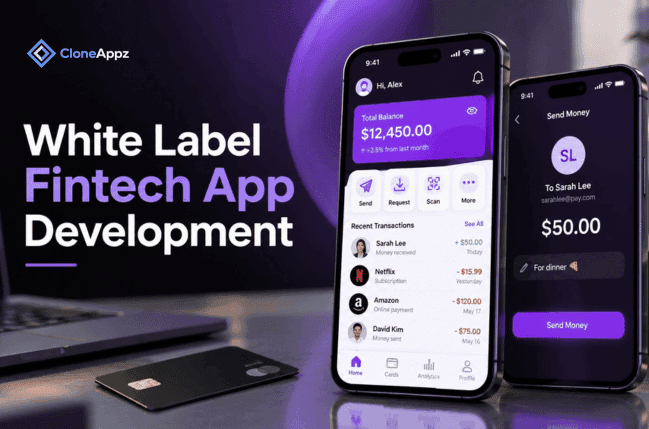
Every fintech idea eventually hits the same wall. You have the vision, maybe even a few investors nodding along in meetings. Then someone mentions licensing, core banking infrastructure, and a compliance team you don't have yet.
Suddenly your 6-month launch plan looks like a 2-year slog.
This is exactly why so many founders are turning to a white label fintech app instead of building one from the ground up.
It is not a shortcut for the lazy. It is the same move smart operators have been making in software for decades: buy the plumbing, focus your energy on the brand and the customer experience sitting on top of it.
By the end of this guide, you will know what a white label fintech platform actually includes, how a white label P2P fintech app like a Cash App clone gets built, and what separates a genuinely strong provider from a reskinned demo with a fancy sales deck.
We wrote this from the seat of a team that builds these platforms every week, so expect fewer generalities and more of what actually matters when you're the one signing the contract.
What is a White Label Fintech App? (And What it isn't)
A white label fintech app is pre-built financial software that you rebrand and launch under your own name. The backend, the core banking logic, the compliance scaffolding, and often the mobile app shell already exist.
Your job is to apply your brand, configure the features you need, and go live. That sounds simple, but the term gets thrown around loosely. Not every "white label" offer is the same thing.
White Label vs. Custom Development vs. Open-Source Forks
Custom development means writing everything from scratch. It gives you total control, but it also means 12 to 18 months of engineering before you process a single real transaction. Most early-stage teams simply don't have that runway.
Open-source forks sit in the middle. You get free code, but you also inherit unpatched vulnerabilities, no vendor support, and the very real risk of building your entire product on a project that gets abandoned next year.
A white label fintech platform avoids both traps. You get proven, maintained code, real support, and a launch timeline measured in weeks, not years.
Where Banking-as-a-Service Ends and White Label Begins
This distinction trips up a lot of first-time founders, so let's clear it up. Banking-as-a-Service, or BaaS, is the licensed infrastructure layer underneath everything.
A white label fintech app is what sits on top of that layer: the branded interface, the user experience, and the feature set your customers actually touch.
Think of it in three parts.
First, there's the license, which comes from a regulated bank or an e-money institution. Second, there's the BaaS or API layer that exposes banking functions programmatically. Third, there's the white label frontend, the actual app your users download and open every day.
Understanding this stack matters because it tells you exactly what you're buying and what you still need to arrange separately.
Why Founders are Choosing White Label Fintech Platforms Over Building From Scratch
The numbers here tell their own story.
In 2025, the global fintech market was valued at USD 394.88 billion and is projected to be worth USD 460.76 billion in 2026 and reach USD 1,760.18 billion by 2034, expecting a CAGR of 18.20% during the forecast period.
That is not a niche trend but a fundamental shift in how financial products get built.
The Real Cost of Custom Fintech Development
Building a licensed banking product from zero typically costs somewhere between $5,000 and $35,000. Also note that this cost range might increase due to many factors such as project scope, level of customization, and other client requirements.
That figure includes engineering salaries, compliance consultants, security audits, and the inevitable rework when your first architecture doesn't scale.
Speed to Market: Weeks vs. Years
Speed matters just as much, often more, for founders trying to make it through a funding timeline. A custom build realistically takes 12 to 18 months before launch. A white label mobile banking app, once you've picked the right partner, can be live in a sandbox within weeks and fully launched within 2 to 3 months.
That difference isn't cosmetic. In a market where a competitor could be reading this exact guide right now, a 6-month head start can decide who owns the customer relationship first.
A Quick Reality Check
Here's the part most vendors conveniently skip. White label does not remove every hard decision from your plate. You still need a compliance strategy, even if your provider handles the heavy lifting.
You still need to decide whether to partner under someone else's license or pursue your own down the road. And you still need an actual go-to-market plan, because a great platform with no distribution strategy is just an expensive app nobody downloads.
The Anatomy of a White Label Fintech Platform
Understanding what's actually inside the box helps you ask better questions when you're evaluating vendors. Most solid platforms break down into four layers.
Core Banking and Ledger Layer
This is the system of record that tracks balances, processes transactions, and maintains the ledger integrity that regulators and auditors will eventually scrutinise. Get this layer wrong, and everything built on top of it inherits the problem.
API Integration Layer
APIs are what connect your app to payment rails, KYC and AML providers, card issuers, and currency exchange services. This layer is genuinely the backbone of the entire platform, and it's the part that determines how far you can scale later without a painful re-platforming project.
The White Label Mobile Banking App Itself
This is the part your customers see: the iOS app, the Android app, and increasingly, a web dashboard too. Good platforms let you control the entire visual language, from colour palette to onboarding flow, without touching backend code.
Admin Panel and Back-Office Controls
Nobody talks about this layer enough, but it's where your ops team lives day to day. User management, transaction monitoring, and reporting all happen here. A clunky admin panel turns a great customer-facing product into an operational headache behind the scenes.
At CloneAppz, we build this stack modularly, so wallets, P2P transfers, remittance, and card issuance can each be deployed on their own timeline instead of forcing an all-or-nothing rollout.
White Label P2P Fintech Apps: The Cash App Clone Opportunity
If there's one category driving the most inbound interest right now, it's P2P wallets. And the data backs that up in a way that's hard to ignore.
Why P2P Wallets Are Growing So Fast
The US mobile P2P payments market is expected to hit 2.27 trillion dollars in 2026, up more than 13 percent from the year before. Roughly 81 percent of US consumers used a P2P payment app at least once last year.
Cash App alone is projected to reach 57.8 million users in 2026, generating over 18 billion dollars in revenue.
Those aren't vanity metrics, and they represent a genuine behavioural shift. People no longer think twice about splitting a dinner bill or paying a freelancer through an app, and that habit has created enormous white space for niche and regional players.
Who's Actually Building These Right Now
We're seeing three distinct buyer types.
- Neobanks use P2P wallets as a retention hook.
- Community fintechs build them for specific groups, think campuses, gig worker networks, or diaspora communities sending money home.
- Remittance startups use P2P rails as the entry point before expanding into cross-border transfers.
The Build-vs-License Decision for a P2P Wallet
Here's the honest answer: unless payments infrastructure is your actual core competency, building a P2P engine from scratch rarely makes sense. The transaction speed, fraud detection, and compliance requirements are punishing to get right the first time.
A white label digital wallet solution gives you a tested foundation, and you spend your engineering hours on the features that actually differentiate you.
Best White Label Fintech Platforms for Digital Wallets and Remittance: What to Actually Look For
This question comes up constantly, and honestly, there's no single "best" answer that applies to everyone. What matters more is knowing which criteria to weigh before you sign anything.
Licensing and Compliance Coverage
Check whether the provider has built-in KYC and AML modules, and whether they hold or partner under relevant licenses in the regions you're targeting. Regulatory requirements shift constantly, and a platform that hasn't kept pace will quietly become your problem later.
API Integration Depth
Look closely at which payment rails, card networks, and forex providers the platform already connects to. A shallow API layer might look fine in a demo, but it will limit you the moment you try to add a feature the vendor didn't originally plan for.
Customization Ceiling
Ask directly: how much of this app can actually carry my brand and my roadmap? Some platforms let you change a logo and little else; others give you real architectural flexibility. Know which one you're buying before you commit.
Source Code Ownership vs. Rented SaaS Access
This distinction matters more than most founders realize upfront. If you're renting access to someone else's SaaS platform, you're permanently dependent on their pricing and their roadmap.
If you own the source code, you control your own destiny, even if you eventually outgrow the original vendor relationship.
Remittance-Specific Requirements
For anyone building toward the best white label remittance platforms for the fintech digital wallets category, a few extra boxes need checking.
You'll want multi-currency ledger support, transparent FX margin controls, and clear corridor coverage for the countries your users actually send money to and from.
Red Flags Worth Watching For
If a vendor can't explain their compliance model in plain language, that's a warning sign. If their demo only shows the happy path, dig deeper. The best white label digital banking platform for fintech providers will walk you through failure scenarios just as confidently as success ones.
How White Label Mobile Banking Apps Handle Security and Compliance
Security isn't a feature you bolt on later. It has to be embedded from day one, and it's usually the single biggest thing that separates a trustworthy platform from a risky one.
KYC and AML Automation
Modern white label platforms automate identity verification and transaction monitoring rather than relying on manual review queues. This matters both for regulatory compliance and for user experience, since nobody wants to wait three days to open an account.
Data Protection and Encryption Standards
End-to-end encryption, tokenization of sensitive card data, and PCI DSS certification should be table stakes, not premium add-ons. If a vendor treats these as optional extras, that tells you something about how seriously they take security.
Regional Licensing Pathways
You generally have two routes here. You can partner under a licensed entity's existing regulatory umbrella, which is faster, or you can pursue your own license, which takes longer but gives you more independence long term. Most founders start with the first option and revisit the second once they've proven traction.
What Compliance Actually Looks Like in Year One
Nobody tells founders this part, so we will. Year one compliance is mostly about documentation, audit trails, and responsiveness, not perfection. Regulators generally care more about a functioning control framework than a theoretical ideal.
API Integration: The Real Backbone of Any White Label Fintech App
We touched on this earlier, but it deserves its own space because it's genuinely the difference between a platform that scales and one that stalls.
Payment Gateway and Card Network Integrations
Your app needs to talk to Visa, Mastercard, and regional payment rails without friction. The quality of these integrations directly affects transaction success rates, and a few percentage points here translate into real revenue at scale.
Open Banking and Account Aggregation APIs
These connections let users link external bank accounts, which is often the first thing they want to do after downloading your app. Weak aggregation support here is one of the fastest ways to lose a new user in the first five minutes.
Third-Party Plug-Ins
Credit scoring services, identity verification tools, and ledger reconciliation software all plug in through this same layer. The more open the API integration framework, the easier it is to add these later without a full rebuild.
Why This Determines Your Future Scale
A platform with rigid, closed APIs might work fine for your MVP. But the moment you want to add a new payment corridor or a lending feature two years from now, that rigidity becomes expensive. API-first architecture isn't a buzzword here. It's the actual mechanism that keeps your options open.
From MVP to Full-Scale Platform: A Realistic Build Roadmap
Let's walk through what an actual timeline looks like, because vague promises of "fast launch" don't help anyone plan a real budget.
Phase 1: Defining Scope and Choosing Your Platform
This stage usually takes 1 to 2 weeks. You're deciding which features matter for launch, which regions you're targeting, and which white label fintech platform actually fits those requirements.
Phase 2: MVP Development
MVP development typically runs 4 to 8 weeks. The goal here isn't to include everything you can imagine. It's to launch the smallest version that lets real users complete real transactions, so you can start learning from actual behaviour instead of assumptions.
Phase 3: Branding, Customization, and Regulatory Alignment
Running partly in parallel with development, this phase covers your visual identity, onboarding flows, and making sure your compliance documentation is actually ready for launch. Expect 2 to 4 weeks here, depending on how many regions you're covering.
Phase 4: Launch, Monitoring, and Iterative Scaling
Once you're live, the real work starts. Transaction monitoring, user feedback, and iterative releases keep the product improving instead of stagnating. Most teams treat the first 90 days as an extended beta, and that's usually the right instinct.
A realistic end-to-end timeline runs 8 to 12 weeks from kickoff to public launch, assuming scope stays disciplined.
Choosing the Right Partner is the Real Decision
Here's the thing nobody says out loud enough. The platform matters, sure, but it's rarely the deciding factor in whether a white label fintech app actually succeeds. Support responsiveness, source code transparency, and roadmap flexibility usually matter more than any single feature comparison chart.
Plenty of founders pick a platform, launch fast, and then hit a wall six months in when they need something the vendor can't or won't build. The ones who avoid this outcome usually choose their partner as carefully as they choose their technology.
Why CloneAppz for White Label Fintech App Development
We'll keep this section short, because you've read enough marketing copy for one blog post and heard enough about white label app development. Here's what actually matters about working with us.
You get full source code ownership, which means no permanent vendor lock-in and no rug-pull risk if our roadmap ever diverges from yours.
Our architecture is modular by design, so wallets, P2P transfers, remittance features, and card issuance can each launch independently rather than forcing a single massive release.
We've delivered white label neobank, wallet, and P2P builds across multiple markets, and our support doesn't stop at launch. Customisation and API expansion continue as your platform grows.
Frequently Asked Questions
A white label fintech app is pre-built financial software that businesses rebrand and launch as their own. It includes core banking functions, compliance tools, and often a ready-made mobile app, letting companies offer financial services without building infrastructure from scratch.
Costs generally range from 50,000 to 500,000 dollars depending on customisation depth, licensing arrangement, and target markets. This compares to 1 million dollars or more for a fully custom, licensed banking product built from the ground up.
Yes, provided the underlying banking services are delivered through a properly licensed institution or BaaS partner. The white label brand itself doesn't need its own banking license, but compliance with KYC, AML, and regional financial regulations is still required.
Banking-as-a-Service is the underlying licensed infrastructure and API layer that powers financial products. White label banking is the finished, branded product built on top of that infrastructure and delivered directly to end customers.
Yes. A white label P2P fintech platform typically includes instant transfers, linked cards, and bill-splitting features similar to Cash App, which you can then customize with your own branding and niche-specific functionality.
Most launches take between 8 and 12 weeks from initial scoping to public release, assuming a reasonably focused feature set. This is significantly faster than the 12 to 18 months typical of custom-built banking products.
Not necessarily. Most white label fintech apps operate under a partner's existing banking license or e-money institution license, which is why the model is faster to launch than building a licensed bank from scratch.
At minimum, look for instant transfers, linked card issuance, transaction history, and KYC-compliant onboarding. Depending on your audience, remittance support, bill-splitting, and micro-savings tools are common additions worth considering.