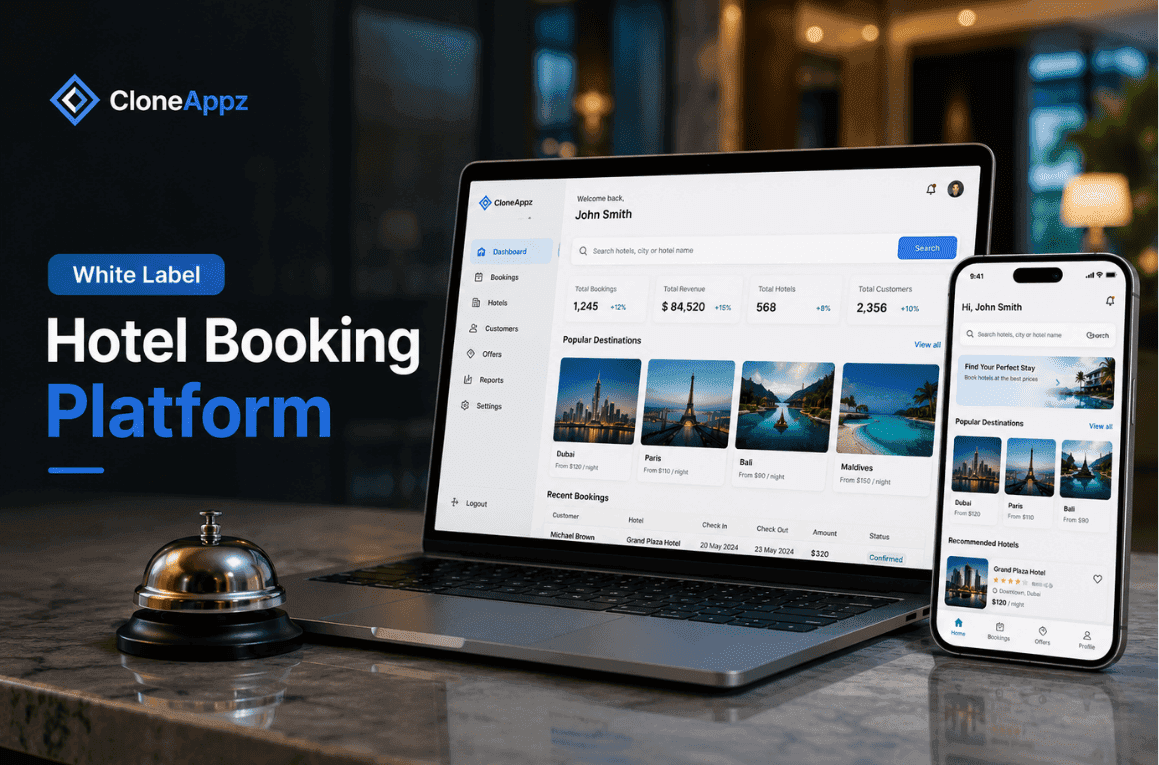
White Label Hotel Booking Platform: Complete 2026 Guide
White label hotel booking platform guide: how it works, costs vs building in-house, must-have features, and how to choose the right providers for your OTA.
10 min read
Picture this. A travel entrepreneur has a solid idea, a decent budget, and zero patience for waiting a year to launch. She calls three development agencies. Each one quotes a different number, a different timeline, and a different set of "it depends" clauses.
Twelve months and a chunk of her savings later, she might have a working hotel booking site, or she might not.
This is the exact fork in the road that pushes so many OTAs, travel agencies, and hotel groups toward a white label hotel booking platform instead. Rather than building the plumbing from scratch, you license a ready-made system, set your brand on it, and go live in weeks rather than years.
It sounds almost too simple. So this guide breaks down what these platforms actually are, how they work, what separates a good one from a mediocre one, and how to decide if buying beats building for your business.
What is a White Label Hotel Booking Platform?
Strip away the jargon and a white label hotel booking platform is simple.
It is a fully functional hotel reservation system, built and maintained by a technology provider, that you sell to customers under your own brand name.
- Your logo sits on the homepage.
- Your domain shows up in the browser bar.
- Your customers never know, or care, which company wrote the code behind it.
Think of it like a private-label product on a supermarket shelf. The manufacturer does the hard part, you do the branding, the marketing, and the customer relationship.
The same logic applies to a white label hotel booking engine. The heavy lifting of supplier integrations, server uptime, and payment security happens behind the scenes, while your name does the talking out front.
What You Own vs What the Provider Handles
This split matters more than most buyers realize before they sign a contract. Get it wrong and you end up paying for a platform that quietly limits how much control you actually have.
You typically own your brand identity, your domain, your pricing and markup structure, and every scrap of customer data that flows through bookings. The provider, meanwhile,
- Takes care of the technology stack
- The connections to hotel suppliers
- Ongoing maintenance
- System security
It is a fair trade in most cases. You are not a software company, so why act like one?
How it Differs from an OTA Affiliate Model
A lot of first-time buyers confuse white label hotel booking software with an OTA affiliate programme, and the difference is bigger than it looks.
In an affiliate setup, a customer clicks your link but finishes the booking on someone else's website. Booking.com or Expedia keeps the customer relationship, you get a small referral fee and little else.
A white label hotel reservation system flips that entirely. The customer searches, books, pays, and receives their confirmation without ever leaving your platform. You keep the data, and the margin.
Why Travel Businesses are Moving to White Label Hotel Booking Software
The shift toward white label isn't a trend dreamed up by software vendors trying to sell more licences. It is a response to real numbers that keep pointing in the same direction.
The global hotel reservation software market was valued at roughly 1.13 billion dollars in 2026 and is projected to nearly double by the early 2030s, growing at close to 9 to 10 percent a year according to multiple market research firms.
That is not a niche corner of travel tech. That is a fast-moving category that more businesses are buying into every quarter, and white label options make up a growing share of that spend because they remove the biggest barrier to entry: development time.
The Real Cost and Time of Building In-House
Building a hotel booking system from the ground up is not a weekend project, no matter what a freelance developer on a forum might tell you.
Realistically, a custom build takes somewhere between twelve and twenty-four months once you factor in supplier API integrations, payment gateway compliance, security testing, and the inevitable delays.
Budgets in the range of six figures are common, and that is before ongoing maintenance costs kick in.
Compare that to a white label hotel booking platform, which can go from contract signature to live website in a matter of weeks. For a founder trying to catch a seasonal travel spike or beat a competitor to market, that time difference is not a nice-to-have. It is the whole game.
Commission Leakage from Relying on Third-Party OTAs
Here's a stat that tends to wake people up. Online travel agencies still account for roughly 55 percent of global travel bookings, and most of them charge commissions of 15 to 25 percent per booking, sometimes more for premium placement.
If your business runs 50,000 dollars a month through third-party OTAs, you could be handing over 7,500 to 12,500 dollars every single month just for the privilege of visibility.
A white label hotel booking engine does not eliminate the need for smart marketing. But it does let you keep direct bookings entirely in-house, which means that money stays in your business instead of funding someone else's ad budget.
Speed to Market as a Competitive Advantage
There's an old line in travel tech circles: the platform that launches first usually wins the loyalty, not the one that launches best.
It's a bit dramatic, but there's truth in it.
A regional travel startup that gets its branded booking platform live in six weeks starts collecting bookings, reviews, and repeat customers while a slower-moving competitor is still in development meetings.
The faster you launch, the sooner you gain data, bookings, and brand recognition that your competitors don’t have yet.
Two Ways to Get a White Label Hotel Booking Engine
Most articles on this topic assume there's only one flavour of white label. There isn't, and the distinction matters for your budget and your timeline.
API-Led Platforms (Connect-and-Configure Model)
This is the more commonly discussed model. A provider gives you access to their existing infrastructure through an API, you configure branding and business rules on top, and suppliers stay connected on the provider's side.
It works well for businesses that need deep, ongoing supplier flexibility and are comfortable paying recurring SaaS-style fees indefinitely.
Ready-Made, Fully Built White Label Software (the CloneAppz Approach)
The second model, and the one CloneAppz specializes in, is different. Instead of renting access to a shared platform, you get a fully built, source-available hotel booking application that is yours to deploy, brand, and adapt. It's closer to buying a house than renting an apartment.
Why a Pre-Built Codebase Can Mean a Faster, Lower-Cost Launch
A pre-built white label hotel booking platform skips the discovery calls, the phased rollouts, and a lot of the back-and-forth that eats up weeks in an API-integration project. The core booking flow, admin dashboard, and payment logic already exist and have already been tested.
Your team focuses purely on branding, content, and local market configuration, which tends to compress the launch timeline even further and keeps costs more predictable over the long run.
Must-Have Features in a White Label Hotel Reservation System
Not every platform marketed as "white label" actually delivers what a serious travel business needs. Before signing anything, run down this list.
- Multi-supplier and channel connectivity: The more hotel inventory sources connected, the fewer gaps your customers will hit at checkout.
- Full branding and domain control: Your logo, your colours, your domain, on every single page and email.
- Booking engine, payments, and admin dashboard: Look for a clean back office that lets non-technical staff manage bookings and view reports without calling support every time.
- Mobile readiness and multi-currency support: More than 60 percent of OTA transactions now happen on mobile devices, so a desktop-first design simply won't cut it anymore.
- Scalability for B2B and B2C use cases: Even if you only need consumer-facing booking today, a platform that can later support agent portals saves a painful migration down the line.
Who Should Consider a Branded Hotel Booking Platform?
A white label hotel booking platform isn't built for one type of buyer. Here's where it tends to make the most sense.
Travel Startups and New OTAs
If you're launching a new OTA brand, a white label hotel booking system removes the single biggest obstacle: the technology build. You get to focus your limited runway on marketing, partnerships, and customer acquisition instead of debugging supplier APIs at 2am.
Travel Agencies Expanding into Direct Booking
Agencies that have historically relied on phone bookings or third-party portals often reach a point where a branded, self-serve booking platform becomes necessary to stay competitive. It lets them capture direct online revenue without abandoning their existing client relationships.
Hotel Groups and Property Management Companies
Multi-property hotel groups sometimes use white label booking software to give every property in the portfolio a consistent, centrally managed booking experience, without hiring an internal engineering team to maintain it.
How to Choose the Right White Label Hotel Booking Platform Provider
The market is crowded, and not every vendor is upfront about limitations until after you've signed a contract.
Questions to Ask Before Signing a Vendor
- Ask exactly how many suppliers are pre-connected, and whether you can add your own contracted rates alongside them.
- Ask what happens when a supplier changes its API, and who is responsible for fixing it.
- Ask for a real uptime guarantee in writing, not a vague promise on a sales call.
Red Flags in White Label Travel Booking Contracts
Watch out for vendors who charge steep fees to unlock your own booking data, or who lock branding customization behind expensive add-on tiers. If a provider is secretive about ownership terms for your domain or customer data, that's a conversation worth having before you commit, not after.
CloneAppz's White Label Hotel Booking Platform: What Sets It Apart
Ready-to-Deploy Architecture Built for Speed
CloneAppz builds its white label hotel booking platform as a complete, ready-to-launch product rather than a shared multi-tenant system. That means your deployment isn't waiting in a queue behind other clients' configuration requests.
Full Customization Without Vendor Lock-In
Because you receive a fully built application rather than restricted API access, your team has genuine flexibility to adapt features, branding, and business logic as your business grows, instead of being boxed into whatever the vendor's roadmap allows.
Support Beyond Launch
Launch day isn't the finish line. CloneAppz stays involved after go-live, helping with updates, troubleshooting, and scaling support as your booking volumes grow.
Final Thoughts: Is a White Label Hotel Booking System Right for Your Business?
There's no universal right answer here.
If your business needs deep, constantly evolving access to dozens of live supplier feeds and you're comfortable with an ongoing SaaS relationship, an API-led white label platform might suit you better.
If speed, ownership, and long-term cost predictability matter more, a ready-built white label hotel booking platform like the one CloneAppz offers is worth serious consideration.
What's clear either way is that building a hotel booking system entirely from scratch is a shrinking option for most travel businesses. The market has moved, the tools have matured, and the businesses moving fastest are the ones no longer trying to reinvent the wheel.
Frequently Asked Questions
It's a pre-built hotel reservation system that a technology provider develops and maintains, which you deploy and sell under your own brand name, logo, and domain.
Costs vary widely depending on the delivery model. API-led platforms typically involve a setup fee plus ongoing monthly charges, while ready-built platforms can involve a more predictable one-time licensing structure. Get a direct quote based on your specific requirements rather than relying on published averages.
Yes. In fact, smaller agencies often benefit the most, since a white label platform removes the need for an in-house development team that a small business usually can't afford to hire.
In an affiliate model, the customer completes their booking on a third party's website and you earn a referral commission. With a white label hotel booking platform, the entire transaction happens on your own branded platform, and you keep the customer data and full booking margin.
Timelines depend on the model. Ready-built white label platforms can go live in a matter of weeks, while more complex API-integration projects sometimes take a bit longer depending on how many suppliers and markets are involved.
Most established providers allow you to plug in your own contracted supplier rates alongside any pre-connected inventory, giving you both breadth and the ability to differentiate on pricing.