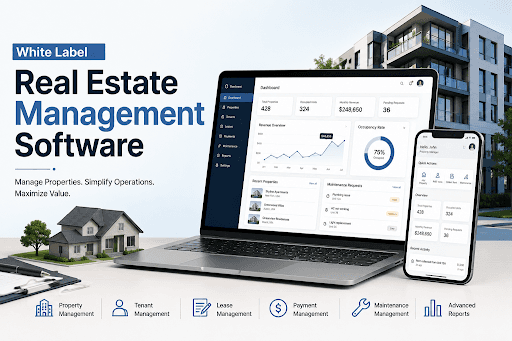
Custom White Label Real Estate Management Software Development
Build scalable custom white label real estate management software with AI, automation, and enterprise features. Develop your solution with CloneAppz.
10 min read
The real estate industry has undergone a remarkable transformation over the last decade. Digital technologies are redefining how investors, developers, brokers, property managers, and tenants interact throughout the property lifecycle. Traditional spreadsheets and disconnected management systems are no longer sufficient to handle growing portfolios, complex transactions, regulatory compliance, and customer expectations.
Businesses today require comprehensive digital platforms capable of managing everything from property listings and tenant communication to investment tracking, maintenance requests, financial reporting, and project execution. This is where white label real estate management software becomes an ideal solution.
Rather than investing years in developing software from scratch, businesses can leverage a customisable platform that accelerates deployment while maintaining complete branding ownership. CloneAppz specialises in delivering scalable white label solutions that enable businesses to launch feature-rich property management platforms with enterprise-grade capabilities.
This comprehensive guide explores every aspect of custom white label real estate management software development, including architecture, features, technology stack, AI integration, development process, costs, and future trends.
Understanding White Label Real Estate Management Software and Why Businesses Are Investing in It
Modern property businesses operate across multiple business functions simultaneously. They manage properties, investors, developers, maintenance vendors, legal documentation, customer support, leasing operations, financial accounting, analytics, and compliance.
Managing these operations manually often results in operational inefficiencies, delayed decision-making, inconsistent customer experiences, and increased administrative costs.
White label real estate management software offers a ready-to-customise digital infrastructure that businesses can brand as their own while incorporating unique business workflows.
Unlike off-the-shelf SaaS platforms with limited flexibility, custom solutions provide complete control over features, branding, integrations, security policies, and scalability.
These platforms help organisations automate repetitive workflows while creating a unified ecosystem for internal teams and external stakeholders.
Some major users include:
- Property management companies
- Real estate agencies
- Construction firms
- Commercial developers
- Residential developers
- Real estate investment companies
- Co-living businesses
- Vacation rental businesses
- REIT operators
- Brokerage firms
Why the Demand for White Label Platforms Is Growing Across Global Real Estate Markets
The global real estate sector is becoming increasingly data-driven. Investors expect transparency, tenants demand seamless digital experiences, and property managers require automation to reduce operational overhead.
Custom platforms allow businesses to:
- Reduce operational costs
- Improve customer experience
- Automate manual processes
- Increase staff productivity
- Centralise business operations
- Improve investment visibility
- Enhance financial reporting
- Accelerate project delivery
- Scale across multiple cities and countries
A branded solution also strengthens customer trust while eliminating dependence on third-party software vendors.
Core Business Challenges Solved Through Real Estate Management Software
Property businesses often struggle with fragmented systems that fail to communicate with one another.
Common challenges include:
Managing Multiple Properties Efficiently
Growing portfolios often become difficult to monitor without centralised dashboards.
Software enables administrators to:
- View occupancy rates
- Track revenue
- Monitor maintenance
- Manage leasing
- Analyse performance
- Generate reports
Handling Complex Financial Operations
Real estate businesses process:
- Rent payments
- Investor distributions
- Mortgage records
- Tax calculations
- Vendor payments
- Utility expenses
- Maintenance budgets
Automation significantly reduces accounting errors.
Improving Tenant Experiences
Modern tenants expect digital-first services such as:
- Online rent payments
- Maintenance requests
- Digital agreements
- Push notifications
- Chat support
- Document uploads
These capabilities improve customer satisfaction while reducing operational workload.
What Makes a Successful White Label Real Estate Management Platform
A successful platform combines user experience, automation, scalability, security, and business intelligence.
Essential qualities include:
- Modular architecture
- Cloud infrastructure
- High performance
- Enterprise security
- API-first development
- AI capabilities
- Responsive design
- Cross-platform accessibility
Essential Features Every Modern Real Estate Platform Should Include
Property Listing Management
Administrators should be able to:
- Create listings
- Upload images
- Add virtual tours
- Configure pricing
- Manage availability
- Categorise properties
Tenant Management
The platform should maintain complete tenant profiles, including:
- Identity verification
- Lease history
- Payment history
- Communication logs
- Support tickets
Lease Management
Automated lease management includes:
- Digital signatures
- Lease renewals
- Expiry reminders
- Compliance tracking
- Contract storage
Maintenance Management
Maintenance modules typically support:
- Service requests
- Vendor assignment
- Priority management
- Status tracking
- Cost reporting
Payment Management
Integrated payment systems simplify:
- Rent collection
- Deposits
- Refunds
- Online invoices
- Automated receipts
Reporting Dashboard
Executives require real-time analytics covering:
- Occupancy
- Revenue
- Expenses
- ROI
- Cash flow
- Property performance
Role-Based Access Control Improves Operational Security
Large organisations require multiple user roles.
Typical user groups include:
Super Administrator
Responsible for:
- Business settings
- User permissions
- Platform configuration
- Global reports
Property Manager
Can:
- Manage tenants
- Approve maintenance
- Update listings
- Track occupancy
Tenant
Can:
- Pay rent
- Raise maintenance requests
- Access agreements
- Receive notifications
Vendor
Can:
- Accept jobs
- Upload invoices
- Update work status
Investor
Can:
- Monitor investments
- Download reports
- View project progress
- Track returns
AI Is Transforming Property Management Software
Artificial intelligence is becoming a competitive advantage across modern platforms.
AI-powered capabilities include:
Smart Property Recommendations
Recommendation engines analyse customer behaviour to suggest relevant properties.
Predictive Maintenance
Machine learning identifies equipment likely to fail before breakdowns occur.
AI Chatbots
Virtual assistants provide instant responses for:
- Property enquiries
- Booking requests
- Maintenance updates
- Lease information
Automated Document Processing
AI extracts information from:
- Contracts
- Agreements
- Invoices
- Identity documents
Fraud Detection
Machine learning identifies suspicious financial transactions and unusual user activity.
Modern Technologies Used During Real Estate Management Software Development
Technology selection directly impacts software performance and scalability.
Frontend technologies include:
- React
- Angular
- Vue.js
- Flutter
Backend technologies include:
- Node.js
- Laravel
- Django
- .NET
Database options include:
- PostgreSQL
- MySQL
- MongoDB
- Redis
Cloud infrastructure may include:
- AWS
- Microsoft Azure
- Google Cloud
Storage services:
- Amazon S3
- CloudFront
- CDN
Security technologies:
- JWT Authentication
- OAuth 2.0
- SSL Encryption
- MFA
Building Enterprise Architecture for Long-Term Growth
Enterprise software should follow a modular architecture rather than a monolithic design.
Recommended architecture includes:
Presentation Layer
Handles user interfaces across web and mobile applications.
Business Logic Layer
Processes workflows, permissions, financial operations, and automation.
Data Layer
Stores:
- Property information
- Customer data
- Financial records
- Documents
Integration Layer
Connects with external platforms through secure services.
Microservices architecture improves scalability while allowing individual services to evolve independently.
Development Process for White Label Real Estate Management Software Development
Building enterprise software requires a structured development lifecycle.
Requirement Discovery
Development teams analyse:
- Business objectives
- User personas
- Market opportunities
- Technical requirements
UI and UX Design
Designers create:
- User journeys
- Wireframes
- Interactive prototypes
- Dashboard interfaces
System Architecture
Engineers prepare:
- Database structures
- Cloud infrastructure
- Security framework
- Integration strategy
Development
Development typically proceeds module by module using Agile methodologies.
Testing
Quality assurance includes:
- Functional testing
- Performance testing
- Security testing
- Regression testing
- API testing
- User acceptance testing
Deployment
Applications are deployed using CI/CD pipelines for continuous delivery.
Maintenance
Post-launch services include:
- Feature upgrades
- Bug fixes
- Security updates
- Infrastructure monitoring
How Real Estate Investor Management White Label Software Helps Investment Companies
Investment firms require significantly more than property management.
They need comprehensive investment intelligence that supports better financial decision-making.
A robust real estate investor management white label software solution enables businesses to manage investor onboarding, capital contributions, ownership structures, dividend distribution, document sharing, investment performance, compliance reporting, and portfolio analytics from a single platform.
It also improves transparency by providing investors with secure dashboards that display project milestones, returns, financial statements, and historical investment performance in real time.
Benefits of Choosing White Label Real Estate Management Software Development Instead of Building from Scratch
Developing software entirely from the ground up requires significant investments in research, engineering, testing, infrastructure, and maintenance.
Businesses choosing white label real estate management software development gain access to a mature technical foundation that dramatically reduces development timelines while allowing extensive customisation based on operational requirements.
Some key advantages include:
- Faster market launch
- Lower development costs
- Flexible branding
- Enterprise security
- Scalable architecture
- Easier maintenance
- Faster feature expansion
- Better return on investment
Why Real Estate Development Management Software Is Becoming Essential for Developers
Large-scale construction and property development projects involve hundreds of interconnected activities, including budgeting, contractor coordination, procurement, scheduling, inspections, approvals, documentation, and stakeholder communication.
Modern real estate development management software centralises these processes within a single platform, helping developers reduce delays, improve collaboration, monitor budgets, manage risks, and maintain complete visibility throughout the development lifecycle.
This level of automation significantly improves project execution while reducing administrative complexity.
Business Modules Included in Enterprise Real Estate Platforms
Enterprise platforms typically include multiple interconnected modules.
These include:
CRM Module
- Lead management
- Customer communication
- Sales pipeline
- Marketing automation
Accounting Module
- Financial reporting
- Expense tracking
- Tax management
- Profit analysis
Facility Management Module
- Asset management
- Vendor management
- Equipment monitoring
Analytics Module
- Occupancy reports
- Revenue forecasting
- Investment analysis
- Business intelligence dashboards
Security Best Practices for Property Management Software
Security is critical because platforms process financial and personal information.
Recommended practices include:
- End-to-end encryption
- Role-based permissions
- Audit logs
- Backup strategies
- Disaster recovery
- GDPR compliance
- SOC 2 readiness
- Multi-factor authentication
Integration Capabilities That Improve Business Productivity
Enterprise software should connect seamlessly with third-party business systems.
Common integrations include:
- Payment gateways
- Accounting software
- CRM platforms
- GIS mapping services
- Digital signature platforms
- Government compliance systems
- Marketing automation tools
- Communication platforms
Businesses planning advanced api integration can automate data exchange between internal systems, external CRMs, accounting software, payment providers, and property listing portals without disrupting existing workflows.
Future Trends Shaping Real Estate Management Software Development
The industry continues evolving rapidly.
Emerging technologies include:
- Artificial Intelligence
- IoT-enabled buildings
- Blockchain property records
- Predictive analytics
- Smart contracts
- Digital twins
- Voice-enabled management
- AR property visualisation
Companies investing in real estate management software development today are positioning themselves to adopt these innovations with minimal infrastructure changes in the future.
How Commercial Real Estate Development Project Management Software Supports Large Enterprise Projects
Commercial developments involve multiple contractors, consultants, architects, financial institutions, and government authorities working simultaneously.
Commercial real estate development project management software provides centralised planning tools that simplify scheduling, milestone tracking, procurement management, budgeting, contractor coordination, risk management, compliance documentation, and executive reporting.
This enables commercial developers to improve collaboration while maintaining better control over project timelines and operational costs.
Why Businesses Choose CloneAppz for Custom Real Estate Software Development
Selecting the right technology partner determines the long-term success of any digital transformation initiative.
CloneAppz delivers enterprise-grade software tailored to the unique operational requirements of property businesses worldwide. Our development team focuses on scalable architecture, cloud-native infrastructure, intuitive user experiences, advanced security, and future-ready technology that supports long-term business growth.
From requirement analysis and UI design to deployment, maintenance, AI implementation, and enterprise integrations, CloneAppz provides complete end-to-end development services for organisations looking to build highly customised real estate management platforms.
Whether your business manages residential properties, commercial assets, investment portfolios, or large-scale construction projects, our experienced engineers develop solutions that improve efficiency, reduce operational costs, and accelerate business growth.
Businesses expanding into adjacent digital property solutions can also explore our white label real estate app offerings for customer-facing mobile experiences that complement back-office management systems.
For organisations validating new ideas before a full-scale launch, our mvp development services help reduce investment risk while enabling faster product validation and iterative feature expansion.
Companies aiming to build marketplace-style property discovery platforms often choose our Zillow clone solutions to accelerate development while supporting extensive customisation and enterprise scalability.
Conclusion
Digital transformation has become a necessity for modern real estate businesses seeking operational efficiency, improved customer experiences, and sustainable growth. A custom white label real estate management platform empowers organisations to centralise operations, automate complex workflows, improve financial transparency, and scale confidently as business demands evolve.
By combining advanced technologies, cloud infrastructure, AI capabilities, enterprise security, and flexible architecture, businesses can build software that delivers long-term competitive advantages. CloneAppz provides end-to-end custom development services that enable property companies, investors, developers, and commercial enterprises to launch scalable, fully branded solutions designed for future growth.
Frequently Asked Questions
White label real estate management software is a pre-built yet fully customisable platform that businesses can brand as their own for managing properties, tenants, investors, maintenance, finances, and business operations without developing software entirely from scratch.
The development timeline generally ranges from 4 to 10 months depending on project complexity, feature requirements, third-party integrations, security needs, and custom workflows.
Yes. AI can power predictive maintenance, smart property recommendations, document automation, chatbot assistance, fraud detection, analytics, and customer support to improve operational efficiency.
Yes. Cloud infrastructure provides scalability, automatic backups, high availability, disaster recovery, enhanced security, and better performance for growing businesses.
Absolutely. Enterprise platforms are designed to manage multiple residential, commercial, and mixed-use properties across different cities, regions, or countries from a unified dashboard.
The cost typically ranges from USD 4,000 to USD 40,000+, depending on the number of modules, AI capabilities, integrations, infrastructure requirements, custom workflows, and ongoing maintenance needs.